You don't need a bigger following. You need to actually exist online.
Here's the reality of dental social media in 2026: most practices have an Instagram account with a profile photo, a bio that says "Family & Cosmetic Dentistry," and a last post from 14 months ago. Some have nothing at all.
If that sounds like your practice, you're in the majority. And the dentists who do post regularly aren't doing it because they have more free time or a bigger budget. They figured out a system. That's the only difference.
This guide is for the dentist who has zero social media presence, or who tried and quit. No theory. No "top 10 content ideas" lists. Just the practical steps to go from invisible to findable, and how to stay there without losing your mind or your evenings.
The real reasons nobody talks about.
You tried and it didn't work.
You posted for two weeks. Maybe three. Nothing happened. No new patients called. No comments. A few likes from your staff and your mom. So you stopped. That's the most common story in dental social media. Not "I never tried." It's "I tried and quit." As Artem S. puts it: "90% of businesses on social media... you can see the last post was made like over 50 weeks ago or 100 weeks ago. That means they just simply gave up because social media requires lots of effort."
You don't know what to post.
You're a dentist, not a content creator. You went to dental school, not film school. The idea of planning content, writing captions, picking music, and editing video feels like an entirely different profession. Because it is.
You don't have time.
Your schedule is packed with patients. Lunch breaks are short. Evenings belong to your family. The idea of adding "social media" to your daily routine is exhausting before you even start.
You tried assigning it to staff.
Your front desk person posted a few times. Then Monday got busy. Then it never came back. This happens in nearly every practice that tries the "just have someone on staff do it" approach. "Tell your front desk receptionist to shoot some content. It's not sustainable because on some days they'll be busy, they have other duties."
What worked before doesn't work now.
Some practices had decent results with social media in 2018 or 2019. Simple photo posts, Canva graphics, a stock image with a dental fact. "Most businesses I spoke with, they always say these things worked in 2018 up until 2020, which is true. There was far less content creators, less content available." The platforms changed. Video took over. The old playbook stopped producing results, and nobody handed you the new one.
None of these are failures. They're friction points. And every single one of them is solvable.
It's not about going viral. It's about being findable.
Let's clear something up. A strong dentist social media presence doesn't mean millions of followers. It doesn't mean dance trends or comedy skits. It means this: when a potential patient searches for a dentist, looks at your Instagram, or sees your name on TikTok, they find a real, active practice with real content.
That's it. That's the bar.
A patient considering dental implants searches "dental implants near me" on TikTok. They see a video of a dentist in their city actually placing an implant. They watch. They check the profile. They see more videos, consistent posting, real procedures, a provider who clearly knows what they're doing. They book.
That's what social media presence means for a dental practice. Not fame. Findability.
"You don't need lots of views, you don't need to go viral to get a client. If you showcase the exact problem, the algorithm will show this to the person who has that problem."
Your content doesn't need to entertain millions. It needs to answer the specific question that your future patient is already searching for. A 45-second video about what to expect during a root canal doesn't need 100,000 views. It needs to reach the 300 people in your city who are nervous about their upcoming root canal. The algorithm handles that targeting for you.
So when we talk about building a dental social media strategy, we're not talking about becoming an influencer. We're talking about showing up where patients are already looking, with content that proves you're the right choice.
You don't need ideas. You need to film what you already do.
The biggest misconception about social media for dental offices is that you need to create something new. You don't. The content exists inside your practice every single day.
Procedure videos.
You perform dental implant placements, root canals, extractions, crown preparations, and cleanings every day. Each one is a video. "Let's say you're a dentist, you're shooting a procedure, a root canal or dental implants. Somebody can just hold the camera while you're explaining what you're doing." That's real content. Thirty seconds of raw footage is enough.
Before-and-after results.
Invisalign outcomes, whitening results, veneer placements, smile makeovers. Two photos or a quick video showing the transformation. This is the content that gets saved, shared, and sent to friends who are considering the same treatment.
Provider clips.
You explaining something to a patient. Why you recommend a particular treatment. What recovery looks like. How long Invisalign takes. You do this all day already. The only difference is whether a camera captures it.
Patient education.
The questions your patients ask you every day are the exact same questions people search on social media. "Does a root canal hurt?" "How long do dental implants last?" "What's the difference between a crown and a veneer?" Each answer is a post.
Office and team moments.
New equipment, office tours, staff introductions, a quick clip of your team before the day starts. This humanizes your practice. Patients feel like they know you before they walk through the door.
You're not creating content from nothing. You're capturing what already happens. The shift is mental, not creative.
Day by day, nothing complicated.
If you have zero social media presence or a dead account, here's exactly what to do in your first week. No strategy deck. No content calendar. Just action.
Day 1: Set up or clean up your profiles.
If you don't have accounts, create them on Instagram and TikTok. Use your practice name. Add your address, phone number, and a one-line description of what you do. Use a real photo of your office or team as the profile picture. Not a logo. People connect with faces, not graphics. This takes 20 minutes.
Day 2: Film one procedure.
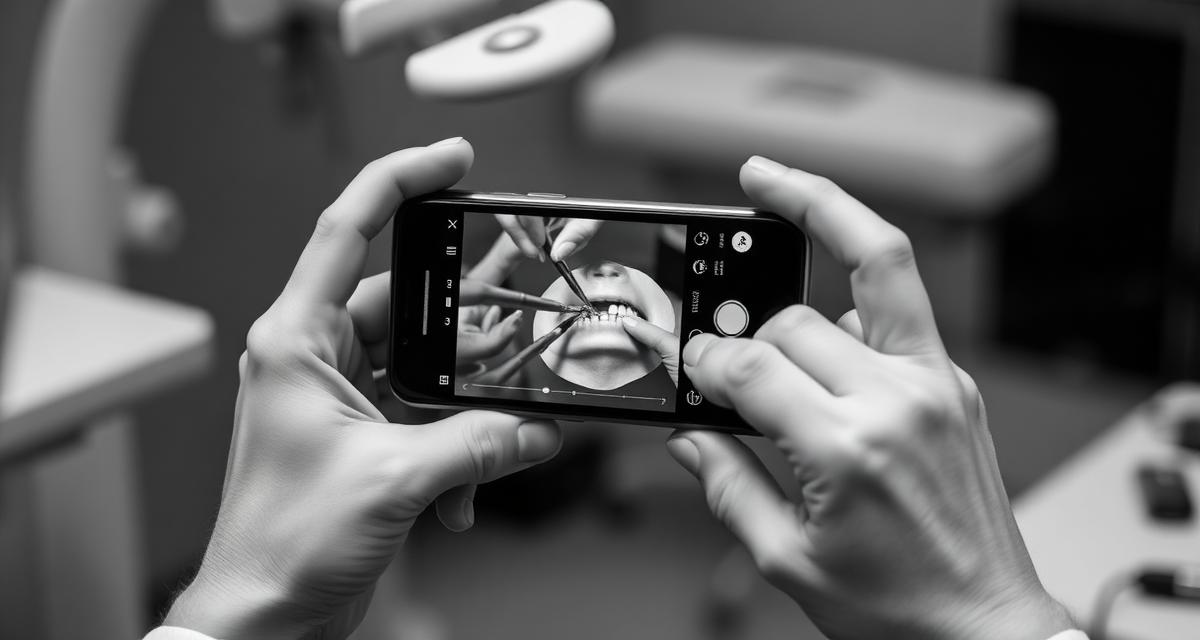
Have someone on your team hold a phone during any procedure. Thirty seconds minimum, two minutes maximum. Don't worry about angle, lighting, or audio. Just capture the procedure. That's your first piece of raw footage.
Day 3: Post your first video.
If you have someone who can do a basic edit, great. If not, post the raw footage with a simple caption describing the procedure. "Dental implant placement, start to finish." Done. It won't be perfect. It doesn't need to be.
Day 4: Film a talking-head clip.
Stand in front of your phone for 60 seconds and answer one question your patients always ask. "How long does Invisalign take?" or "What happens during a root canal?" Speak like you're talking to a patient. Because you are.
Day 5: Post the talking-head clip.
Same as Day 3. Simple caption. Post it.
Day 6: Film a before-and-after.
Pull a recent case with a great result. Take two photos or film a quick reveal. Post it with a caption about the treatment.
Day 7: Review what happened.
Check your views. Check if anyone followed you. Don't evaluate results yet. The only metric that matters this week is: did you post three times? If yes, you're ahead of 90% of dental practices.
The goal of Week 1 isn't growth. It's proving to yourself that you can post. That's the foundation everything else builds on.
Where to post and why each one matters.
You don't need to be on every platform. But you need to understand what each one does so you can pick the right starting point for your dental social media strategy.
TikTok.
This is where new patients discover you. TikTok's algorithm shows your content to people based on their interests and location, not just who follows you. A dental implant video from a dentist in Phoenix gets shown to people in Phoenix who have been watching dental content. You don't need followers. You need content. TikTok is the best discovery engine for dental practices right now.
Instagram.
This is where patients check you out before booking. When someone hears about your practice, the first thing they do is look at your Instagram. If your last post is from a year ago, that's a red flag. If your feed shows real procedures, real results, and recent activity, that builds trust. Instagram is your credibility layer. Reels (Instagram's short video format) works the same way as TikTok and should get the same content.
YouTube Shorts.
This is the search engine play. People search YouTube for "what to expect during a root canal" and "Invisalign before and after." YouTube Shorts answers those searches with short videos. Your content lives on YouTube for months, even years. It compounds. A video you post today can still bring patients to your profile a year from now.
Facebook.
This is where the 35-55 demographic lives. Parents looking for a family dentist. Adults considering cosmetic work. People with dental insurance shopping for a provider. Facebook feels older, but your highest-value patients are on it. Don't skip it.
The real advantage: cross-posting. One video works on all four platforms. The same 30-second clip of a procedure reaches younger patients on TikTok, builds credibility on Instagram, answers searches on YouTube, and reaches older demographics on Facebook. You film once. You post four times. That's how practices go from zero to everywhere without quadrupling their workload.
The algorithm rewards showing up. Not perfection.
This is the part that trips up most dentists. You think your content needs to be professional, polished, perfectly lit, and beautifully edited before you post it. It doesn't.
Here's how social media algorithms work: they reward accounts that post regularly. An account that posts three times a week gets more reach per post than an account that posts once a month, even if that monthly post is a cinematic masterpiece. The algorithm sees consistent activity as a signal that your account is worth promoting. It sees inactivity as a signal that you've quit.
A slightly shaky phone video of a real root canal, posted consistently, outperforms a professionally shot and edited video posted once. Every time.
This doesn't mean quality is irrelevant. It means that consistency is the prerequisite. Get consistent first. Improve quality second.
Three posts a week is the minimum. Five is better. Daily is ideal. But three per week, every week, for six months will change your practice's online presence more than any single viral video.
Ten posts in one week followed by silence is worse than two posts a week for a year. The algorithm interprets gaps as abandonment. It reduces your reach. Your followers forget you exist. When you come back, you're starting from scratch. The practices that win on social media are the ones that show up predictably. Not the ones that show up spectacularly.
The key insight is this: you don't need every post to be great. You need every week to have posts. That's the shift.
This is the real reason dentists quit social media.
Let's be honest about why dental practices stop posting. It's not motivation. It's not content. It's production.
The gap between "raw footage on someone's phone" and "finished post on four platforms" is where everything breaks down. That gap includes: editing the video, writing a hook, adding captions, picking music, timing the cuts, adjusting for each platform's format, writing the caption, and actually uploading and publishing. For one video. On one platform.
Multiply that by four platforms and three posts a week, and you're looking at a part-time job.
Option 1: Do it yourself.
You're a dentist. Your time in the chair is worth hundreds of dollars per hour. Spending two hours in CapCut editing a video costs more than any alternative. And you'll stop within two weeks when the schedule gets busy.
Option 2: Hire a social media manager.
This works if you have the budget. But onboarding takes weeks, turnaround per post is days, and you're paying thousands per month for someone who still needs you to explain what's happening in the procedure. For a solo dentist or small group practice, the math rarely works out.
Option 3: Assign it to staff.
We covered this. It's not sustainable. Your team has other responsibilities. The content stops when they get busy.
Option 4: Remove humans from the production step.
This is where the industry is going. You film. AI handles everything else. Scripting, editing, voiceover, captions, music, branding, publishing. The footage goes from your phone to all four platforms without you or your staff spending time in an editing app.
ReelsDoc is an AI social media editor built for this exact problem. You send raw video or photos through Telegram. The AI scrapes your practice website, learns your services and providers in 60 seconds, and produces a finished post. Captions, music, voiceover, branding included. It publishes to TikTok, Instagram, YouTube, and Facebook simultaneously. Under 5 minutes from raw footage to published. No app to download, no dashboard to learn. Just Telegram.
The point isn't the specific solution. The point is that if production depends on a human finding free time, you will eventually stop posting. Whatever system you choose, the production step has to be solved. That's the difference between practices that build a dentist social media presence and practices that quit.
The path from invisible to consistent.
If you're reading this and your practice has zero social media activity, here's the honest truth: the gap between you and the practices that post regularly is smaller than you think. They don't have more time. They have a system.
Here's how to build yours:
Film something today.
A procedure, a before-and-after, you talking about a treatment for 30 seconds. Don't plan. Just film.
Post it today.
On Instagram, TikTok, or both. Simple caption. No overthinking.
Do it again tomorrow.
And the next day. Build the posting habit before you worry about strategy, aesthetic, or branding.
Solve the production bottleneck in week two.
Once you've proven you can film consistently, figure out how the editing and publishing will work long-term. This is the decision that determines whether you're still posting six months from now.
Add platforms and increase volume.
Start with one platform. Once that's consistent, expand to all four. One video, four platforms, maximum reach.
Or skip the learning curve. Send a video or photos to ReelsDoc and see what comes back. Five free videos, full experience, no credit card. You film for 30 seconds. The AI handles the rest. Under 5 minutes to published. Up to five staff members can share one bot, so your whole team can contribute footage. You can see exactly how the process works here.
Your practice already creates the content every day. The only thing missing is the system to get it online.
FAQ
How can dentists build a strong social media presence from scratch?
Start by filming what you already do. Procedure videos, before-and-after results, and short clips of you explaining common treatments. Post three times a week minimum, focusing on one or two platforms first (Instagram and TikTok are the strongest starting points for dental practices). Consistency matters more than production quality. A dental practice that posts real footage every week will build a stronger social media presence in six months than one that posts perfect content once a month. The key is solving the production bottleneck so content actually gets from your phone to the platforms without depending on someone's free time.
What should dentists post on social media to attract patients?
Post real content from your practice. Procedure videos perform best because patients are genuinely fascinated by dental work. Before-and-after transformations get shared and saved. Provider clips where you explain treatments build trust before a patient ever calls. Patient education content (answering the questions people Google, like "does a root canal hurt" or "how long do dental implants last") gets found through social media search. Avoid stock photos, Canva templates, and generic dental facts. Real footage from your office outperforms polished graphics every time.
Which social media platform is best for dental offices?
TikTok is best for discovery because the algorithm shows your content to people in your area based on interest, not just followers. Instagram is best for credibility because patients check your profile before booking. YouTube Shorts is best for search because dental questions live on YouTube for months. Facebook reaches the 35-55 demographic that books the most dental work. The strongest dental social media strategy uses all four. One video works across all platforms, so cross-posting multiplies your reach without multiplying your effort. If you can only start with one, pick TikTok or Instagram.
How often should a dental practice post on social media?
Three times per week is the minimum to build and maintain a dentist social media presence. Five times per week is better. Daily is ideal. But consistency matters more than frequency. Two posts a week, every week, for a year beats ten posts in one week followed by three months of silence. The algorithm rewards accounts that post regularly and reduces reach for accounts that go quiet. Pick a frequency you can actually maintain and stick with it.
How much does social media marketing cost for a dental practice?
A human social media manager runs $2,000-5,000 per month. An overseas freelancer runs $500-1,500 per month. Doing it yourself costs your clinical time, which is worth far more. AI-powered production like ReelsDoc costs less than what you spend on lunch, handles editing, voiceover, captions, music, and publishing to all four platforms from raw footage sent through Telegram. The right choice depends on your budget and how much of the work you want to handle yourself.
Your next patient is searching social media right now. Are you there?
Film a procedure tomorrow. Send the raw footage to ReelsDoc. See what comes back. 5 free videos, full experience, no credit card.